Your tears are sacred

image

Some things are so big you can’t possibly write about them.

Three months ago I flew to Colorado to spend a week in the wilderness on a vision fast with a group of magnificent women. All the way there I wondered why I was flying halfway around the world to connect with the Earth when I feel so connected to the Australian landscape. The whole journey was about surrender, about feeling called and acting on impulse, about letting myself be helped and carried by the people around me.

When I arrived in Colorado my heart broke open with the beauty of it. Those mountains!! Those delicious, incredible, magnificent mountains. “No wonder” I said to my generous host “American’s like big cars and big houses, anyone would feel insignificant next to that!” I enjoyed feeling dwarfed, having a real sense of my humble place in the scheme of things.

Somehow the long journey, the altitude and the jetlag conspired to leave me vulnerable and weepy but rather than fight it, I saw this as a blessing. It stripped layers of reserve off me, here on the other side of the world, far from family and broken relationships, I could lay down the burden of grief I’d been carrying. I spent much of the first two days in tears, I was beginning to feel self-conscious about it when one of our guides, a woman of few words and an impressive herstory of wild Earth love, looked me in the eye and said “your tears are sacred.”

I cannot tell you the relief those words inspired in me. “Here you are safe,” they said, “Here you are enough. Just be.”  I have had the great honour of offering those four simple words to a number of people in my life. Each time I have witnessed the gentle sag of shoulders as they relax into their grief. Recently as I cried in the arms of my new love, she offered them back to me. What a beautiful place the world would be if we were all able to hold this understanding in our hearts and minds – your tears are sacred.

People seem to fear tears, fear the discomfort of grief but I have found it is only repressed emotion that is truly discomfiting. After and between and through my tears, up there in the mountains, was a boundless joy. The remote valley where we stayed was alive with new creatures and I was in a perpetual state of wonder. Thrilling to the sound of chipmunk chirps, delighting in their feathery tails and observing their movements with rapt attention.  Every bird and butterfly was a visitation, the whole valley seemed to rise to my attention, almost showing off.

Around the circle I laughed at myself, bashfully admitting that I felt like Snow White, surrounded by birds and small mammals. Our guide looked me in the eye once more and said “You have come here, across the world, and offered your loving attention, why would the land not respond to that?”

Last Friday I had the great priviledge of watching Tanderrum, the ceremonial coming together of the five language groups of the Kulin nation, the local Aboriginal people and custodians of the land where I live. It was beautiful and moving, only the second time the ceremony has been carried out since colonisation.  I cried most of the way through for reasons that are difficult to articulate. I kept wondering if it was wrong to cry, disrespectful or embarrassing,  but our guide’s words rang in my head and my heart “your tears are sacred, your tears are sacred, your tears are sacred.”

Wild at heart

I love this article from the Huffington Post UK. It’s an elegant articulation of a number of complex ideas that seem to be coming together in the human psyche at the moment. I have noticed though, that there tends to be an othering of nature that happens as part of this narrative of reconnection. 

wpid-imag0718.jpg
I agree that it’s easier to see ourselves as part of a greater whole when we are overwhelmed by the more than human. Going to places that haven’t been obviously rearranged by human hands can be a humbling experience and that humility is crucial to the shift in consciousness that is needed. But unless we can bring that humility and that recognition of our place in the larger whole into our cities and human communities, our work will be fruitless.
 
This is a critique borne of my own frustration. The conditions of my life require me to live in the city and give me very few opportunities to ‘escape’ into the wilderness. I need to be nourished and nurtured by the more than human world as much as anyone but I can’t do it in the traditional way of ‘going bush.’ I am slowly developing practices for myself that help me ground my sense of connection in the places where I live, work and play. Perhaps the judge sits in my own heart but I feel these practices are overlooked or undervalued by my deep ecology friends and by the broader narrative of ‘nature connection.’ As though they are merely stop gap measures until I can get out into the ‘real’ wildness again.
 
If we are truly to see ourselves as part of nature rather than dominating it we need to radically rethink the dichotomy that says ‘nature’ is in our national parks and not in our cities. We need to take our hearts, awakened to wildness and use them to see the land where we live. Our great teachers in this could well be our children, the young ones haven’t yet learned to pay more attention to ‘human’ objects over non-human ones. Those of us who don’t have children may have memories of the way we used to play, the trees and flowers that drew our attention. The things that fired our imaginations and filled our hearts with joy. As Mary Oliver so eloquently put it we need to “Let the soft animal of [our] body love what it loves” and we need to do it wherever we are. 
 
The day after my walk along Back Creek, a gathering entitled “Rewilding the Urban Heart” was advertised on Facebook – to say that I am excited would be a massive understatement.

Grandmother gum

A friend recently drew my attention to the Radio National Project – Trees I’ve Loved. They asked listeners for stories about their relationships with trees and then selected 40 for production and broadcast. I highly recommend you go and listen, they are mostly only 2-5 minutes long and very moving.

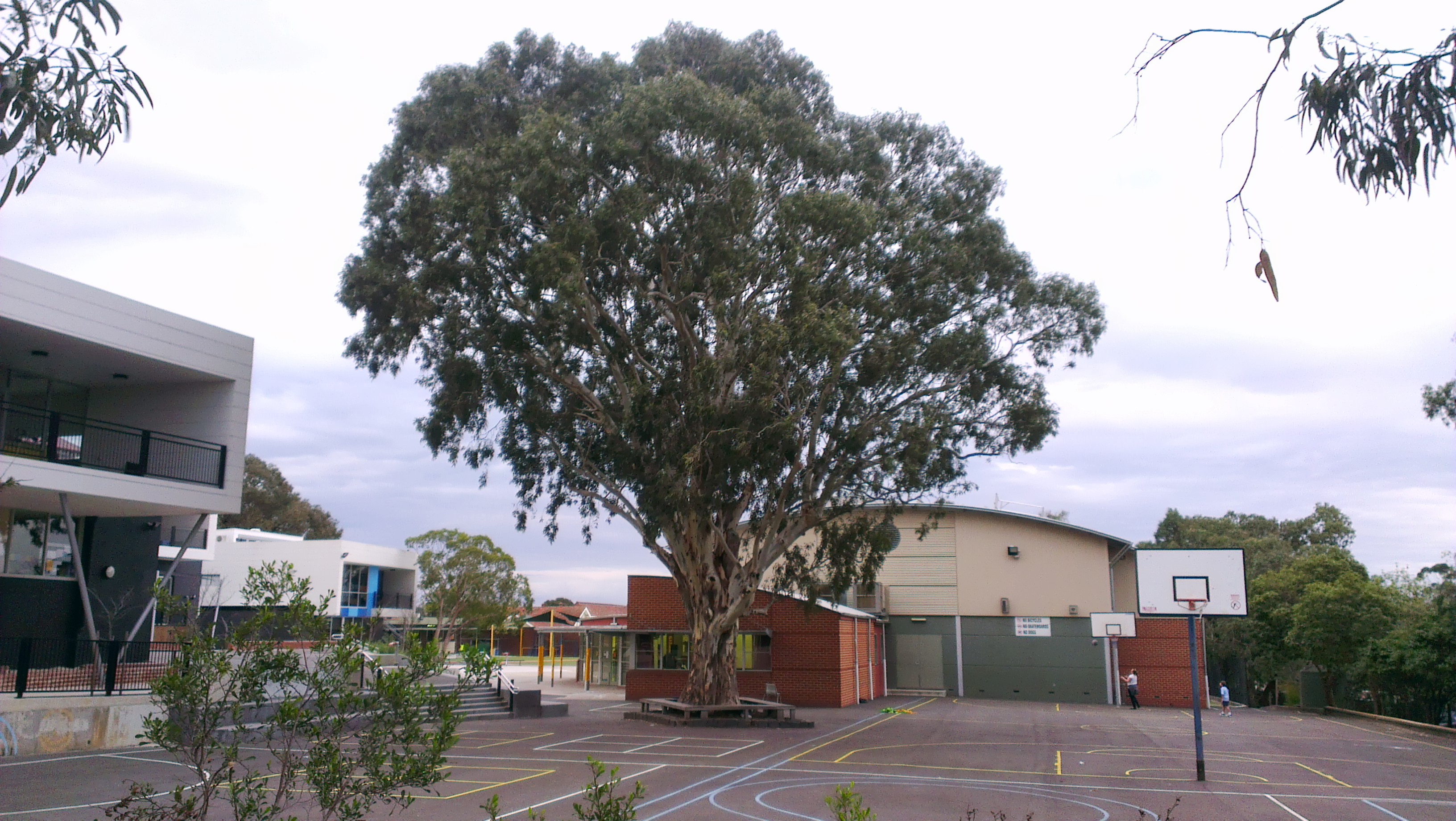
It has inspired me to reflect on my own relationship to trees and particularly Grandmother Gum, the great old gum tree in the grounds of the local primary school. I’ve spoken before about how trees function as a mindfulness bell for me but I find my relationship with this particular tree is deeper than that.

Grandmother Gum

I went to primary school here and the grounds are steeped in memories of humiliation. That’s the bench where I was picked last for rounders, there’s where my ‘friends’ used to enjoy running off on me at random moments (taking advantage of my inability to keep up), and over the back was the library where I took refuge. The buildings are all different now (thankfully) but the ground and my heart hold the memories.

I don’t remember taking refuge in the tree back then but now I feel she was a silent witness to that time in my life. Her boughs sheltered me from the sun as I stood in the outfield lost in my own thoughts, oblivious to the game I was excluded from. It comforts me to know that if my son goes to school here, she will watch over him as she has watched over me.

I have introduced Mr A to the tree and encouraged him to speak with her. The idea has taken root, he refers to her as the Grandmother Tree, and also “your friend, Mama.” Yesterday we went to visit her but the gates were locked. Mr A said “she misses us” and then “I wish there were more Grandmother Trees, out here.” I sighed “Yeah, me too.”

I weep now as I write that, for the kind of world where Grandmother Trees are everywhere and duly respected. The kind of world where trees are actually allowed to grow that old. I am stunned by three and a half year old Mr A’s easy respect for this great being. It comes so naturally to him and yet so many people seem to miss the point, what happened?

I fear for the future of this precious tree. A family friend in the next street once said it’s a Corroboree Tree (a tree that predates colonisation where people would have gathered). I’ve looked for scars and found none so it can’t be verified. I find myself wanting to contact the Koorie Heritage Trust, to ask someone to come out and assess it. I want her to be protected. I also want other people to recognise that she’s special, perhaps to validate the depth of my own feeling. I feel lonely in my love for her, a weird hippie.

On the other side of the school there’s a mosaic that features local landmarks like the train-line and the creek. Along the top, holding it all in its generous embrace are the boughs of the Grandmother Gum. So perhaps I am not alone, other people honour her too. The school grounds are radically different than the days of my childhood but she is untouched.

The Radio National tree project is further evidence of the fact that people care about trees, find solace and joy in them, feel deeply for and about them, and grieve their loss. I wish this were more a part of our culture, that there were more places and spaces to speak of our connections, that trees were more deeply appreciated.