On grief

Grief came in the night and curled up on my chest
I woke to it staring me in the face
Placid, implaccable but somehow menacing.

As I stared into those yellow, unblinking eyes, it’s tail began to lash.
I grabbed it with firm hands,
Craning my neck to avoid a counter attack
And sat up, slowly, expecting it to drop to the floor
instead I felt its claws.

Pin pricks became angry red lines raking downward hot and heavy.
It clung, ripping, tearing but never letting go
Pulling great wracking sobs out of me
Dragging at my heart through my ribcage
Sinking it’s teeth into delicate flesh.

I thought I would die.

Body tense, teeth clenched, hands fisting away tears.
I stretched beyond breaking,
torn asunder but somehow inescapably still here.
Every part of me pinned by claw or tooth
Laid out, throbbing
A dissection of human suffering.
Helpless.

I gave up.
Stopped pushing, stopped fighting, stopped trying to be free.

I laid each hand across my heart and wept.

Of their own volition, my hands found soft fur
Drew my fingers in long, languid strokes.

The pain ebbed,
The cat
purred.

Grandmother gum

A friend recently drew my attention to the Radio National Project – Trees I’ve Loved. They asked listeners for stories about their relationships with trees and then selected 40 for production and broadcast. I highly recommend you go and listen, they are mostly only 2-5 minutes long and very moving.

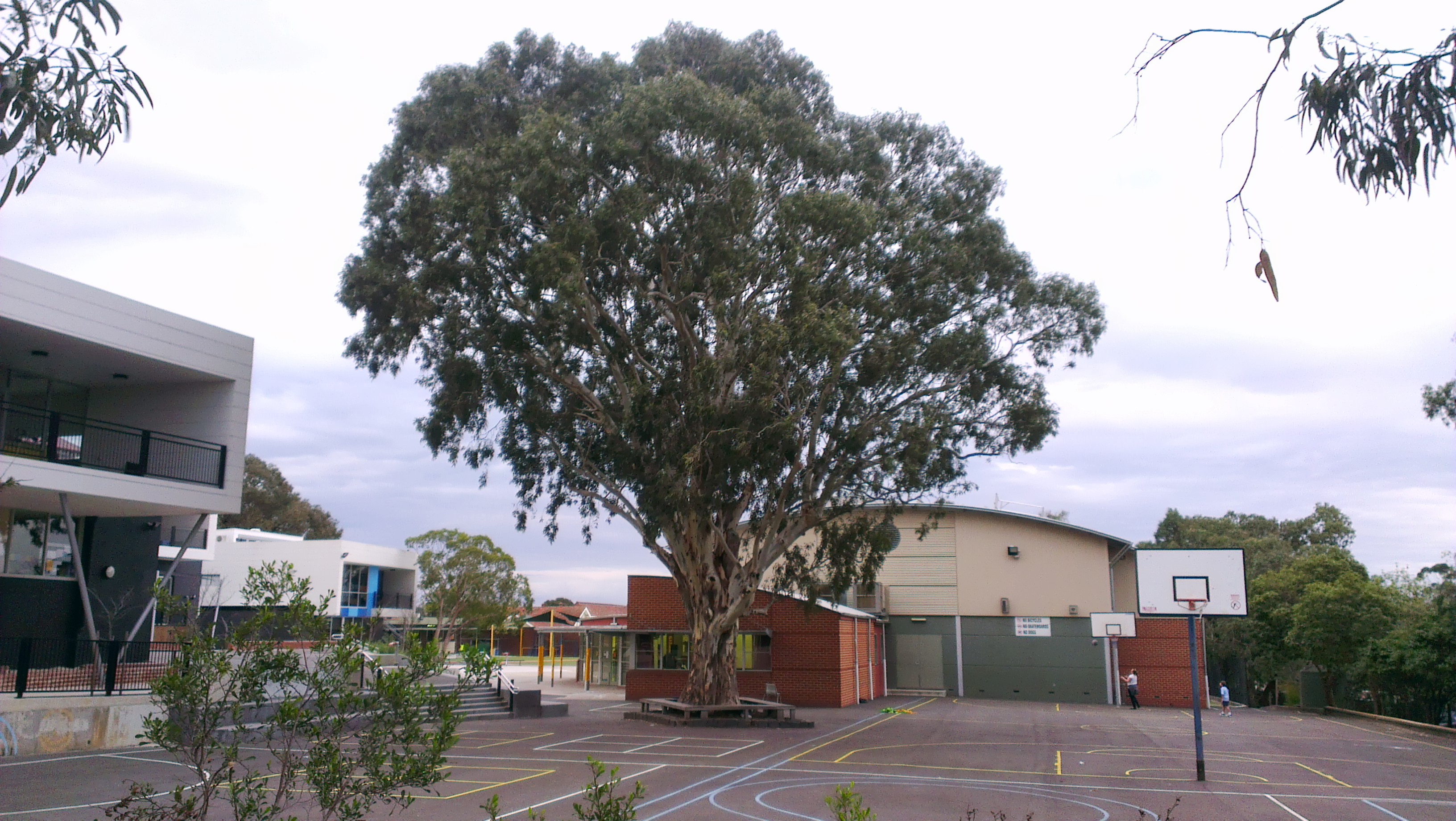
It has inspired me to reflect on my own relationship to trees and particularly Grandmother Gum, the great old gum tree in the grounds of the local primary school. I’ve spoken before about how trees function as a mindfulness bell for me but I find my relationship with this particular tree is deeper than that.

Grandmother Gum

I went to primary school here and the grounds are steeped in memories of humiliation. That’s the bench where I was picked last for rounders, there’s where my ‘friends’ used to enjoy running off on me at random moments (taking advantage of my inability to keep up), and over the back was the library where I took refuge. The buildings are all different now (thankfully) but the ground and my heart hold the memories.

I don’t remember taking refuge in the tree back then but now I feel she was a silent witness to that time in my life. Her boughs sheltered me from the sun as I stood in the outfield lost in my own thoughts, oblivious to the game I was excluded from. It comforts me to know that if my son goes to school here, she will watch over him as she has watched over me.

I have introduced Mr A to the tree and encouraged him to speak with her. The idea has taken root, he refers to her as the Grandmother Tree, and also “your friend, Mama.” Yesterday we went to visit her but the gates were locked. Mr A said “she misses us” and then “I wish there were more Grandmother Trees, out here.” I sighed “Yeah, me too.”

I weep now as I write that, for the kind of world where Grandmother Trees are everywhere and duly respected. The kind of world where trees are actually allowed to grow that old. I am stunned by three and a half year old Mr A’s easy respect for this great being. It comes so naturally to him and yet so many people seem to miss the point, what happened?

I fear for the future of this precious tree. A family friend in the next street once said it’s a Corroboree Tree (a tree that predates colonisation where people would have gathered). I’ve looked for scars and found none so it can’t be verified. I find myself wanting to contact the Koorie Heritage Trust, to ask someone to come out and assess it. I want her to be protected. I also want other people to recognise that she’s special, perhaps to validate the depth of my own feeling. I feel lonely in my love for her, a weird hippie.

On the other side of the school there’s a mosaic that features local landmarks like the train-line and the creek. Along the top, holding it all in its generous embrace are the boughs of the Grandmother Gum. So perhaps I am not alone, other people honour her too. The school grounds are radically different than the days of my childhood but she is untouched.

The Radio National tree project is further evidence of the fact that people care about trees, find solace and joy in them, feel deeply for and about them, and grieve their loss. I wish this were more a part of our culture, that there were more places and spaces to speak of our connections, that trees were more deeply appreciated.
Sherbrooke Yatra

Sunday was a big day of protests against our government’s woeful response to climate change. They are actually planning to dismantle measures put in place by the previous government. The loss of the carbon price seems inevitable and yet 60,000 people across the country turned out to protest their intention to repeal it.

I showed my support by participating in a Yatra in Sherbrooke forest above Belgrave. We walked about 7km (the Grants picnic ground loop if you know the area) in silence interspersed with readings and deep ecology exercises from Joanna Macy.
Photographer by a tree

It was a lovely way to do deep ecology, dwarfed by the mountain ash forest and held by it as we walked in silent solidarity.  I was so quickly embraced by the little group although I’d only just met most of them.  I guess you don’t show up for something like that unless you have a particular spiritual bent and it’s a pretty deep place to start from.

It’s reassuring to see the diversity of people who are engaged with deep ecology.  I look forward to the day when Yatras become like 5rhythms and you can be sure there’s one happening somewhere every weekend. We’re building what we need to sustain ourselves not just in environmental activism but in life.

December workshop: Our Earth, Our Self

Reigniting hope and sustaining action in the face of crisis, an experiential workshop.

Child in silouhette watching rhinos

Take a day out from the grind of making social change to connect with like minded people and reignite your passion. The work that reconnects gives us space to feel difficult emotions in a supportive environment and allow hope to arise.

Continue reading

Craft is cool

I’ve been on a craft spree over the last month or so. I’ve made a journal, a dress and some wall art. I lost my phone for three days (which was unnerving and liberating) and was inspired to do a bit of crochet on the train. It has made me think about the value of working with my hands.

girl holds origami butterflies on strings

I once taught someone to crochet and jokingly said “It’s good to have a practical skill come the environmental apocalypse.” Of course I don’t know if that’s where we are headed but it certainly seems like things need to change, (this post articulates it beautifully). One of the things that would have to change is the value of manual labour.

I find it strange sometimes that sitting at a desk pushing paper is valued so much more highly than my ability to create books or clothes. To the point where it’s just not worth trying to sell the fruits of my labour even though I love it. Our economy values the thoughts in my head much more highly than the skills in my hands.

Handbound coptic stitch journal with postcard covers

I admit I find the thought of a reevaluation of this hierarchy … delicious. ‘Craft’ is overlayed with political and cultural connotations that become particularly apparent when one considers its distinction from ‘art‘. According to one scholar “what white European men make is dignified by the label “art”, while what everyone else makes counts only as craft.” I hope for a more socially just world as well as an Earth-caring one and this seems to be one of places where those passions combine.

The trouble with Australian seasons

The following excerpt is taken from my Master’s thesis on seasonal celebrations:

In Australia seasonal variability has been the norm for many thousands of years. From a European point of view it is “a continent characterised by extremes of variation and unpredictability.” (Rose, 2005: 38) The cultural practices of Indigenous Australians, however, have evolved alongside Australia’s changeable weather so that “conditions labelled by whitefellas as ‘very changeable’ [are] in fact ‘entirely natural’” (Rose, 2005: 37). Debbie Bird Rose describes an Indigenous system of understanding and interpreting the seasons according to a range of interrelated events.

Rather than being based on a projection of an annual cycle, seasonal changes are forecast through awareness of changes in flora and fauna and responded to as they occur. “The system is widespread, the content is local. All of it – system and content – is built from extremely longterm observations that have accommodated variability and patchiness and identified precise concurrences.” (2005: 40) Such a system, Rose argues, is impossible to correlate with the European calendar without losing the dynamism that makes it so suited to Australian seasonal conditions. It holds the seeds of a world-view that challenges the European seasonal mind-set and represents a way forward for spiritual ecologists. Rose holds the Indigenous system up as an example to us all of how we can live “in this vulnerable continent.” We can seek to build a relationship with what is happening in the natural world around us by allowing observation to be the basis of ritual.

So as I alluded in my response to some questions on my previous post the notion of ‘indigenous seasons’ is problematic. The familiar 4 season calendar introduced from the north was shaped by an agrarian relationship to the land. There’s a sense in which the whole concept of seasons don’t apply to Australia because of nonannual cycles like El Nino/ La Nina. However the idea of basing rituals on observation presents a great opportunity, particularly as climate change begins to show its teeth.

How this might work in practice I don’t know, I’d love to explore. I imagine a semi-structured ritual that provides space for call and response, litanies of experiences or free flowing physical expression, there’s no limit to the ways you could gather observations. A system of continuously adapting and responding to changes in seasonal patterns is really the only way to maintain a genuine relationship with the land. It also has to be more than human somehow though, we have to allow space for the Earth to speak to us, to feel our small selves within that larger self.

Earth, spirit, community

Five years ago I completed a Master’s thesis called Seasonal Celebrations in the Melbourne Bioregion. It was an exploration of various groups who were attempting to create or adapt seasonal celebrations that are attentive to our local experience of the seasons.

This is particularly pertinent in Australia. As a former British colony a large portion of society here practice cultural traditions that were developed in harmony with a completely different landscape. In case that’s not enough we are in the southern hemisphere so our seasons are opposite to those of the dominant global cultures of US and Europe. The epitome of this is the hot sweaty santa claus in the red fur lined suit on a scorching 35 degree (celcius) day, sitting on a throne surrounded by fake snow and fir trees.

Santa claus at the beach

It makes no kind of sense and yet, what I found when I was discussing my thesis with people was that the pagan elements, the ones that typify an ancient relationship with the Earth (the fir tree, the roast lunch, the stockings by the chimney), are the ones that are closest to people’s hearts. One year, for our extended family Christmas, I subsituted a wattle branch from an overburdened tree that was about to fall over, for the traditional fir tree. All the kids asked where the Christmas tree was and insisted that the wattle was the wrong colour.

I wrote my thesis hoping to discover a spiritual practice that would honour my connection to this country. Not in a patriotic sense, but with a deeply grounded respect for the land that has brought me up, that has been a source of spiritual solace. I found great people doing great work but I did not find my spiritual home.

Return of the Sacred Kingfisher festival at CERES

I love my sense of belonging to Earth. I love feeling awed and humbled and held by something greater than myself. I love feeling that I am part of the richness of the whole Earth community. Thus far my spiritual journey with the Earth has been a solitary pursuit. Some would say that this is a necessity, that it’s not possible to share such a thing in community. I don’t know if that’s true or not but my heart longs to try.

I can’t help but feel that a spiritual community, like the Buddhist jewel of sangha, would help to keep that sense of connection alive and central to my life. Particularly when family, work and home responsibilities prevent me from immersing myself in wilderness.

Wominjeka

Six years ago I did the Aboriginal Heritage Walk through the Melbourne Botanic Gardens. The moment of participating in the welcome ceremony and receiving a gumleaf – symbol of permission to pass through Wurudjeri country – was profoundly moving. I wasn’t aware of the guilt I carried around until that humbling moment. The following extract is taken from my journal at the time:

My head is still spinning. The information is one thing – all the uses of plants, the stories, the words for things, the tools, the place of animals and the interaction between people of different language groups. How do you make sense of such a complex culture in only two hours? … Their whole way of life is different to mine. Their stories overlay the city, I look around and imagine people … interacting here, imagine a whole other landscape with waterfalls and different names.

There’s a song by Tiddas that captures it perfectly “A living history beneath the concrete of the city streets which we walk upon.” When it comes to ecological identity I have so much to learn from Aboriginal Australians. I feel so hesitant though, I desperately want their knowledge but I am so ashamed of the way my people have decimated their culture (and continue to do so). I feel unworthy of the teaching. Then again restoring my own relationship to country and learning to care for it may provide a path to reconciliation.

A friend once told me that he volunteered to support urban Aboriginal people living in poverty.  When I shared my feeling that my relationship to the land was dependent on reconciliation he told me he didn’t think reconciliation would lead us back to the Earth. Instead turning to the Earth and caring for country is the only way nonindigenous Australians could come close to understanding our first peoples.

DEBRIEF: The flow game

Last Sunday I was going to run a workshop but the universe had other ideas. I am prepared to admit that my marketing was a little ad hoc, definitely something to work on in future. However Sunday was strangely perfect.

A week or two before the day it became clear that we were not going to get the numbers to do the Work that Reconnects. I had a day or two of angst over this and then I decided to take the pressure off and change the plan.  My partner in crime, Linette, is a Flow Game host so I decided we could just do that and whoever turned up could join in. If no-one showed up then we could just play by ourselves and it would be a good opportunity to reflect on where the work is going.

As it turned out one other person came along (which was lovely) and it was just as well there weren’t more because the space we planned to use was double booked and we had to move. The venue had a lovely atmosphere and lovely community around it but as a workshop space it was a little chaotic. I think in future I will look for a more contained venue, it could be difficult to create a safe space when other folk need to wander through from time to time.

In a way I’m glad the workshop didn’t go ahead and I got to learn these things gently with the very flexible Flow Game and not the whole Work that Reconnects shebang. The game itself was very enlightening, my question was about grounding a career that is aligned with my purpose. I got a lot of powerful questions in return about talking to people and having meaningful conversations. It inspired me to offer my workmates a taster of last week’s Art of Hosting training (18 people said yes, huzzah). After lunch we were feeling a little questioned out so we spent an hour doing collage and creating visual affirmations to represent the morning’s insights, here’s mine:

Flow Game collage

Going forward Linette and I have agreed to do something (the Flow Game, the Work that Reconnects, some other thing that takes our fancy) every couple of months. As soon as we decide what our next grand adventure will be I will post it here but feel free to drop me a line kiri @humansarenature.com if you’d like a personal invite.

The art of meaningful conversation

Recently I’ve been making connections between a variety of different ideas but haven’t known how to articulate them. There is something about the human need for meaning, belonging and importance that connects to our environmental crisis.

On the one hand I’ve been reading Eckhart Tolle and Brene Brown. I’ve found enormous personal insight in their work and it has helped me to push myself toward being a better and happier person. In the face of environmental crisis it might seem like this personal journey is self-indulgent but it’s not.

Consumption is driven by numbing behaviour, when we take the time to say “I am enough, I have enough, I am grateful” and do the work to believe it and feel it. Then we are freed from the need to consume mindlessly. That’s not even the half of it though, we have gifts to offer the world that we squander in our mindlessness. We are not fulfilling our potential as a species because our greatest creative gifts are burried beneath a flood of stuff.

The pursuit of money over meaning is killing us.

A mind map of the environmental crisis

This week I attended three days of training on the Art of Hosting. On one level what we learned was a collection of tools and group processes for engaging people in generating creative solutions to social problems. What the hosts modeled though were ways to keep people present and engage in meaningful conversation. They drew the group to recognise our common humanity, to step out from behind our professional identities, engage with what matters to us and apply it to our work.

Meaningful conversation is fundamental to society’s transition from destruction to sustainability. When we make peace with the present moment we stop trying to impose our will on the world and come to appreciate what is given and what we have to give. As we realise our fundamental worth we stop needing to prove it with bigger, better, faster, more and we naturally make space for others to be present and call forth their better/higher/buddha nature. This creates the grounds for genuine dialogue, it’s the only way that change can happen and the only way we can come up with the kind of creative and innovative solutions we need.