Surrender

Surrender

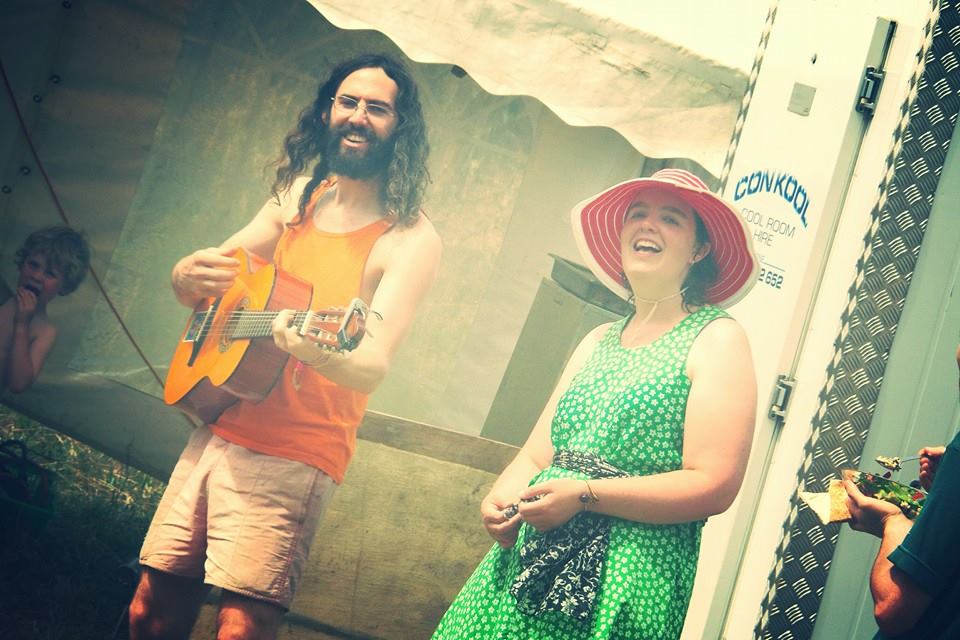
Earlier this year at the Wild Mind festival I attended an embodied writing workshop with Maya Ward. As a poet I expected to write poetry. Much to my chagrin what came to me were some cheerful words and a snippet of melody. A week later it was still running around in my head so, even though I didn’t really like the melody, I took the time to sing it out and write some more lyrics.

The resulting song has been a prayer, an affirmation and a blessing. I have sung it to myself and to other people in my life whenever the reminder to surrender was needed. It has brought numerous people to tears (which I count as a good thing) and brought me enormous peace. Now I finally have the courage to share it:

Serenity, wonder and peace are yours
The infinite mystery of life
Wholeness, connection and balance are yours
If you surrender to strife.

Let go and let come
The earth will keep turning
The work will get done
Let go and let come
The universe is waiting for you.

Kindness, compassion and love are yours
Softness of a warm embrace
Happiness, humour and joy are yours
The laughter of children at play.

Let go and let come…

Silence and stillness and solace are yours
Because sometimes you must go within
Nurturing, comfort and weeping are yours
If you can learn to give in.

Let go and let come…

Envy and anger and greed are yours
Because they too have something to teach
Community,  family and friendship are yours
If in your heart you make peace.

Let go and let come…

The universe is waiting
Your own heart is waiting
And we’re all here waiting for you.

Your tears are sacred

image

Some things are so big you can’t possibly write about them.

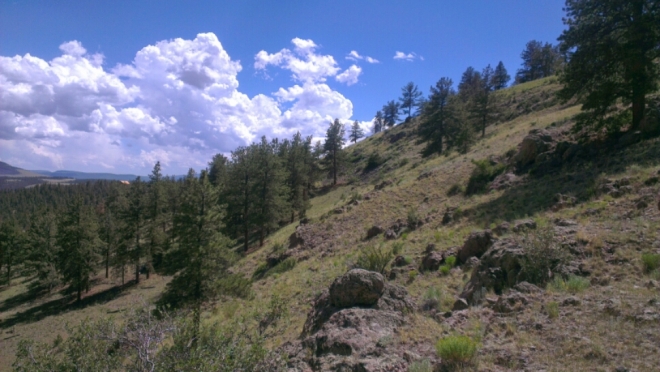
Three months ago I flew to Colorado to spend a week in the wilderness on a vision fast with a group of magnificent women. All the way there I wondered why I was flying halfway around the world to connect with the Earth when I feel so connected to the Australian landscape. The whole journey was about surrender, about feeling called and acting on impulse, about letting myself be helped and carried by the people around me.

When I arrived in Colorado my heart broke open with the beauty of it. Those mountains!! Those delicious, incredible, magnificent mountains. “No wonder” I said to my generous host “American’s like big cars and big houses, anyone would feel insignificant next to that!” I enjoyed feeling dwarfed, having a real sense of my humble place in the scheme of things.

Somehow the long journey, the altitude and the jetlag conspired to leave me vulnerable and weepy but rather than fight it, I saw this as a blessing. It stripped layers of reserve off me, here on the other side of the world, far from family and broken relationships, I could lay down the burden of grief I’d been carrying. I spent much of the first two days in tears, I was beginning to feel self-conscious about it when one of our guides, a woman of few words and an impressive herstory of wild Earth love, looked me in the eye and said “your tears are sacred.”

I cannot tell you the relief those words inspired in me. “Here you are safe,” they said, “Here you are enough. Just be.”  I have had the great honour of offering those four simple words to a number of people in my life. Each time I have witnessed the gentle sag of shoulders as they relax into their grief. Recently as I cried in the arms of my new love, she offered them back to me. What a beautiful place the world would be if we were all able to hold this understanding in our hearts and minds – your tears are sacred.

People seem to fear tears, fear the discomfort of grief but I have found it is only repressed emotion that is truly discomfiting. After and between and through my tears, up there in the mountains, was a boundless joy. The remote valley where we stayed was alive with new creatures and I was in a perpetual state of wonder. Thrilling to the sound of chipmunk chirps, delighting in their feathery tails and observing their movements with rapt attention.  Every bird and butterfly was a visitation, the whole valley seemed to rise to my attention, almost showing off.

Around the circle I laughed at myself, bashfully admitting that I felt like Snow White, surrounded by birds and small mammals. Our guide looked me in the eye once more and said “You have come here, across the world, and offered your loving attention, why would the land not respond to that?”

Last Friday I had the great priviledge of watching Tanderrum, the ceremonial coming together of the five language groups of the Kulin nation, the local Aboriginal people and custodians of the land where I live. It was beautiful and moving, only the second time the ceremony has been carried out since colonisation.  I cried most of the way through for reasons that are difficult to articulate. I kept wondering if it was wrong to cry, disrespectful or embarrassing,  but our guide’s words rang in my head and my heart “your tears are sacred, your tears are sacred, your tears are sacred.”
Wild at heart

I love this article from the Huffington Post UK. It’s an elegant articulation of a number of complex ideas that seem to be coming together in the human psyche at the moment. I have noticed though, that there tends to be an othering of nature that happens as part of this narrative of reconnection. 

wpid-imag0718.jpg
I agree that it’s easier to see ourselves as part of a greater whole when we are overwhelmed by the more than human. Going to places that haven’t been obviously rearranged by human hands can be a humbling experience and that humility is crucial to the shift in consciousness that is needed. But unless we can bring that humility and that recognition of our place in the larger whole into our cities and human communities, our work will be fruitless.
 
This is a critique borne of my own frustration. The conditions of my life require me to live in the city and give me very few opportunities to ‘escape’ into the wilderness. I need to be nourished and nurtured by the more than human world as much as anyone but I can’t do it in the traditional way of ‘going bush.’ I am slowly developing practices for myself that help me ground my sense of connection in the places where I live, work and play. Perhaps the judge sits in my own heart but I feel these practices are overlooked or undervalued by my deep ecology friends and by the broader narrative of ‘nature connection.’ As though they are merely stop gap measures until I can get out into the ‘real’ wildness again.
 
If we are truly to see ourselves as part of nature rather than dominating it we need to radically rethink the dichotomy that says ‘nature’ is in our national parks and not in our cities. We need to take our hearts, awakened to wildness and use them to see the land where we live. Our great teachers in this could well be our children, the young ones haven’t yet learned to pay more attention to ‘human’ objects over non-human ones. Those of us who don’t have children may have memories of the way we used to play, the trees and flowers that drew our attention. The things that fired our imaginations and filled our hearts with joy. As Mary Oliver so eloquently put it we need to “Let the soft animal of [our] body love what it loves” and we need to do it wherever we are. 
 
The day after my walk along Back Creek, a gathering entitled “Rewilding the Urban Heart” was advertised on Facebook – to say that I am excited would be a massive understatement.

Aspen

image

My heart has melted into the humus
Become one with worms, beetles and flies
One with sticks, leaves and soil.

My blood is sap, rising in straight white trunks,
Opening into green, seekers of light,
Shimmering against the blue,
Shivering with the wind’s caress.

I feel my sisters, standing strong around me,
A sacred communion of souls
Many and one, united beneath the Earth.

And I, nestled in the chalice of their regard,
Throwing wide the doors of my heart
Am lost and found among their whispered sighs.

Tributaries

I haven’t written for a little while because I’ve been busy planning an adventure. Ruth over at Inscendence put out a call for women to join a wild nature retreat and vision quest and, since I was looking to justify a trip to Portland a week later for World Domination Summit, I said ‘I’m in.’ I was hoping to make the Back Creek Project happen as soon as I get back but that doesn’t feel very sensible now. I’ve had some good discussions with a few people at council, the local friends group and the Wurundjeri Council but I think it’s worth letting it gestate a little.

In the meantime here are some photos from a bit of reconnaisance I did with a friend of the Denman St portion of the creek:

Back Creek heading into a tunnel IMAG0830

I’ve also been thinking about some of the ideas that precipitated this project, apart from Maya’s beautiful book and wanted to share some with you.

Firstly the Wurundjeri people of the Kulin nations, traditional owners of the land on which I live and work. I have participated in Indigenous history walks in the Botanical Gardens and along the Yarra (covered elsewhere also). Both taught me to see the living history beneath the concrete (as Tiddas so eloquently put it). This insight continues to shape the way I see and relate to the land I pass through every day and forms the backbone of a project like this.
When I was doing my Masters I came across Freya Mathews, her books Reinhabiting Reality and For love of matter challenged me to think differently about where I live. She set a powerful example of living locally and reinscribing urban environments with the sacred.
Dr Peter Cock of Moora Moora taught Social and Sacred Ecology at Monash University. I went on an overnight solo and my spirit animal was a leech. It seemed pretty mundane at the time but when I returned to the city it was wild to think that I had made a blood sacrifice to the bush.
My gratitude must also go to the Grandmother Gum, musk lorikeets, tawny frogmouth, magpies and ravens, ring tail possums, hardenbergia violacea, all these creatures taught me to open my heart, to love the more-than-human. The small, every day visitations that act as a gateway to the enormous reality of our interdependence.

Introducing Back Creek

About seven years ago now I discovered that I have lived by a creek for most of my life. Back Creek is a tributary of Gardiner’s Creek (formerly Kooyongkoot Creek) which is a tributary of the Yarra River (also known as Birrarung).

1871 Map of Boroondara Shire with Back Creek highlighted

This map of the Shire of Boroondara circa 1871 confirms the original path of the creek (and a number of others besides). The green line is Kooyongkoot/Gardiner’s Creek, the light blue is Back Creek and the purple lines are Canterbury, Riversdale and Toorak Roads (from top to bottom), they should help to orient you if you live locally.

In environmental circles it’s widely recognised that connecting with ‘nature’ is important. Most people tend to think that the only way to do this is to go out into the wilderness where the human is dwarfed by the more-than-human. But what if it’s not?

The environmental crisis requires us to live more efficiently, with smaller footprints. It doesn’t make sense for all of us to go and live in the wilderness so we can stay mindful of our true place “in the family of things.” We need to look with new eyes, to see the wildness in our own backyards, our cities and suburbs, to see that we are part of a greater whole no matter where we are.

To this end I am planning a walk along the length of Back Creek. This journey is significant because the reason I didn’t know I lived near a creek is that it mostly runs underground in barrel drains. I’m not sure what it will be like to walk it, whether the land still gives clues as to the creek’s location.

Much of its length is now parkland and walking trails, a few short sections are open to the sky. It is cared for by council staff and ‘friends’ groups made up of local residents. I am in the process of collecting stories and information, if you have any to share please get in touch.

I invite you to join me on an adventure, on Sunday 27 July 2014, into the history of land, people and home. Come see the wildness in our streets. The creek may be covered but traces remain for those with eyes and heart to see.

Pondering proliferation

Mushroom in a forest

Groups are proliferating like mushroom caps pushing their way out of the mycelium net
Svasti, Evolver, Deep Ecology Network, Mother Tongue, Sisters for sisters, Wild Mind, Open Communities, 5rhythms, Dancing Freedom,
So many interesting people and things that I want to support
That I want to be supported by
How to find one’s place amongst all this juicy goodness?

In the language of competition, the world of separation, diversity is bad
But in the language of compassion, the world of connection, diversity is good
In time they will come to occupy their own niches
They will serve the needs of a variety of groups
They will ease the transition from the old story to the new.

So gather good people, recognise the universe in each other, honour our mutual beauty
Support it all because who knows what’s needed
Who knows the value of heeding the call of our hearts?
Some things are worth doing even if you fail
Please yourself, but not by halves, go all the way to the bottom of your heart and let those yearnings guide your actions.

As for me, I’m quite happy to wander around, doing what I please
If others begin to do what I do then I shall leave them to it and wander some other way
Or not
After all my expression, my networks, my calling are my own, unique
Who can say what the outcome might be?

Grief and gratitude

I seem to be pulled toward grief and gratitude at the moment. On the face of it, according to common understanding, it seems incongruous like being pulled in different directions. From the inside though the connection is seamless, grief and gratitude entwine each other, the latter is a balm for the former.

Earlier this year my 4 year old moved up to the kinder room and was quite sad about the loss of his beloved child care room. I mentioned this to a colleague at work who responded with enthusiasm. “That’s great, he must have felt really loved where he was.” Her response shifted my thinking and inspired me to tell Mr A “I know you feel sad and that’s okay. That sadness tells us that we loved something so what we can do is be grateful and say thank you. Thank you child care room, thank you toys, thank you carers.”

Some weeks later I cradled Archie, my beloved dog of ten years, as he lay on the threshold of death. I was moved in that moment of letting go to give thanks for the life we had shared and wrote the below poem in his honour.

Poem of gratitude to my dog

At the Wild Mind Gathering I offered a ritual of grief and later a song of gratitude. The song was inspired by the joy of finding community but the grief of separation was just around the corner. I knew everyone would share my pain at leaving such a beautiful space of connection and sharing, so I offered my thanks for what we had created together.

Joanna Macy says that gratitude is a revolutionary act. Gratitude says “I am enough. I have enough.” The danger in grief is that the pain will lead us down the path of fear and scarcity, closing us off to love. Gratitude stops the descent and holds us in grief as a pure expression of love.

Grief is becoming a friend to me. It shows me that I’m alive, that I am capable of love and that I am engaged in the world. I am learning to be grateful for the pain of grief and finding that the more I embrace it, the more it sets me free and the more open I am to embracing the love that comes my way. I am grateful for all the people, things and moments that I have loved and lost for helping me learn this lesson.

Wild Mind Gathering

I have just had the most incredible weekend. My heart feels full and open, my body is tingling with joy. I am back in the city now but I feel the ancient forest so strongly it’s as if the cicadas, birds and cars are conspiring in an impromptu jam session. How to capture the magnificence of the weekend?

Kiri and Joe singing up a storm of gratitude at the final lunch time queue.

Photo by Ivan Kramer

Continue reading